Journalist/Reporter
Article
This article explains how women have broken barriers over the years to be sports broadcasters.
A Small Breakthrough for Women in Sports Media
Digging deeper into the obstacles women sports journalists face
Women Sports Journalists on “We need to TALK” (Photo courtesy of CBS Sports)
When you turn on the television to a sports show or channel you see men sitting around talking about the plays being made amongst each other. Since the mid 1940s, the sports world has been dominated by men to where the thought of a woman being included was absurd. That was until 1974, when Phyllis George joined CBS as a sportscaster. George was primarily brought on the show as “eye candy” not because she was actually experienced when talking about sports. Phyllis George gained popularity after winning the 1971 Miss America title.
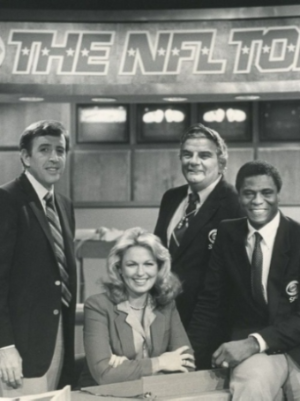
The following year, George became a co-host for “The NFL Today”, becoming the first woman to appear on a live nationally televised sports broadcasting show.
Brent Musburger (left), Phyllis Georger, Jimmy “The Greek” Snyder (second from the right), and Irv Cross (far right) (Photo courtesy of CBS).
In 1978, Jayne Kennedy replaced George on “The NFL Today” breaking barriers herself to become the first African American woman to host a network sports television show. According to a statistics chart done by Zippia for sports broadcasting, 17.2% are women anchors while an astonishing 77.6% are men. With 74.2% being of White race, 12.7% being Hispanic or Latinos, Black or African American being 8.1%, 2.1% Asian and 1.1% American Indian or Alaska Native.
There was some controversy in 1978 because women weren’t allowed in the locker room like men were. It became a legal battle when Melissa Ludtke sued The New York Yankees forty-three years ago for banning her from doing interviews in the locker room for the 1977 World Series. This gave their male peers an advantage. They came to the conclusion that neither men nor women would be allowed to do interviews inside the locker room but instead in a neutral location. This was for the privacy of the athletes and to protect the women reporters from sexual assault.
Gayle Gardner was the first woman to land a job on ESPN from 1987-1993. She is said to be the most famous sports journalist. Now, we have many women working on ESPN. Heidi Watney is the mail journalist for the Major League Baseball (MLB) Network show titled “Quick Pitch” that airs daily giving highlights for all MLB games that took place that day. Alongside Watney there is Kelly Nash, Sam Ryan and Lauren Gardner, who also on some days host Quick Pitch.
Heidi Watney in MLB’s Studio 21 on the set of “Quick Pitch” ( Photo courtesy of MLB Network)
Veronica Palacios, who is a Sports Enthusiast, looks forward to the start of the NFL season every year to play Fantasy Football. But playing in a fantasy football league as a woman comes with negativity.
“Every year, I get messages of people laughing at me for drafting the players I chose,” said Palacios. “This year, I got shit for choosing a place kicker for my second pick.” Palacios chose Baltimore Ravens place kicker Justin Tucker for her fantasy team.
Palacios attends California State University, Los Angeles and is pursuing a career in Sports Marketing. Although it is not journalism, it is still in the field of sports and she knows she has some obstacles to get through. The most common question women face is “Do you even know the rules of sports?”
According to Global Sports Matters and the U.S. 2019 Census, women get paid eighty-two cents for every one dollar earned by men in the same field. Both men and women can do the same job but men will always be superior.
Not only is it hard for women sports journalists, but its hard for women athletes as well. According to Niemanlab.org, 80% of televised sports news and highlights 0% was on women's sports. The coverage for women’s sports has been very low for the past couple of years. In the 2019 study, Niemanlab concluded that 95% of coverage was solely on men's sports. The graph below is from niemanlab.org.
Although there is plenty of room for improvement, one woman, Lesly Vessir, became the first female NFL analyst and was recognized by the Pro Football Hall of Fame. According to Entity, women are categorized for how they look and dress, more than what they actually know about sports. When looking up information about women in sports media, all the articles that come up are titled “Top 25 Hottest Sports Reporters” which always has something to do with the appearance of women.
In the Youtube video below men read the hateful comments directed at women sports journalists.
In an article by Quartz, there are some tweets women have received.
“I still get tweets to go back to the kitchen.”
“I’ve gotten tweets that the only reason I have a job is because of my looks; I’ve also gotten plenty more tweets that, you know, I’m an unattractive reporter who shouldn’t be on television.”
“I hope you get raped again.”
“One of the players should beat you to death with their hockey stick like the whore you are.”
All very negative things to say to a person only trying to do their job.
Ericka Alarcon, who is a huge Los Angeles Dodgers fan, likes attending home games at Chavez Ravine. But before she can make it there she has to hear some choice words from friends and family members.
“When I tell my family I am going to a Dodgers game they tell me ‘You just like going to see the players, not the actual game’,” says Alarcon.
Alarcon is just one of the many women who enjoy and actually understand sports but yet get caught in the stereotype of “women do not know sports like men do.”
“I just stare at them with a blank face because I know whatever I say is not going to change their minds.”